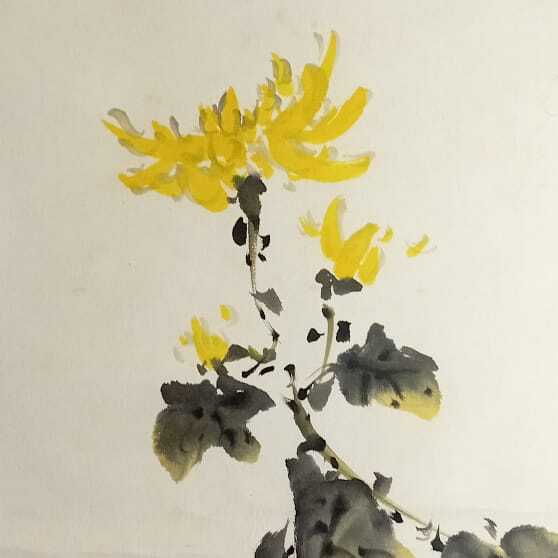
Hirose Fukashi - Camellia - postwar Japanese modernist painting on shikishi
Vintage Japanese painting on shikishi by Hirose Fukashi depicting a red camellia.
The work belongs to the later postwar Shōwa period. The inscription “77” appears beside the artist’s personal red seal and likely refers to Hirose’s age, which would place the work around 1979-1980. It reflects the modernist and abstract visual language he developed after the war. Hirose’s intimate shikishi works can be seen as a two-dimensional extension of his sculptural practice, reducing plants, animals, and human figures to concise, plastic forms.
Hirose Fukashi (1903-1983) was a Japanese modernist sculptor and abstract artist from Fukuoka, and a full member of the sculpture section of Nika-kai. Before the war he worked mainly in figurative sculpture, while in the postwar period he turned toward abstraction and developed his own language of simplified forms.
He participated in the establishment and postwar revival of the Fukuoka Prefectural Art Association and later served as its vice chairman. His works are held by the Fukuoka Art Museum and the Fukuoka Prefectural Museum of Art. In 1980, he received the Fukuoka City Culture Award for sculpture.
One of Hirose’s most unusual public works was a monumental white-cement Brontosaurus created for Fukuoka Zoo in 1955. The surviving sculpture later became a local Fukuoka legend.
The work belongs to the later postwar Shōwa period. The inscription “77” appears beside the artist’s personal red seal and likely refers to Hirose’s age, which would place the work around 1979-1980. It reflects the modernist and abstract visual language he developed after the war. Hirose’s intimate shikishi works can be seen as a two-dimensional extension of his sculptural practice, reducing plants, animals, and human figures to concise, plastic forms.
Hirose Fukashi (1903-1983) was a Japanese modernist sculptor and abstract artist from Fukuoka, and a full member of the sculpture section of Nika-kai. Before the war he worked mainly in figurative sculpture, while in the postwar period he turned toward abstraction and developed his own language of simplified forms.
He participated in the establishment and postwar revival of the Fukuoka Prefectural Art Association and later served as its vice chairman. His works are held by the Fukuoka Art Museum and the Fukuoka Prefectural Museum of Art. In 1980, he received the Fukuoka City Culture Award for sculpture.
One of Hirose’s most unusual public works was a monumental white-cement Brontosaurus created for Fukuoka Zoo in 1955. The surviving sculpture later became a local Fukuoka legend.