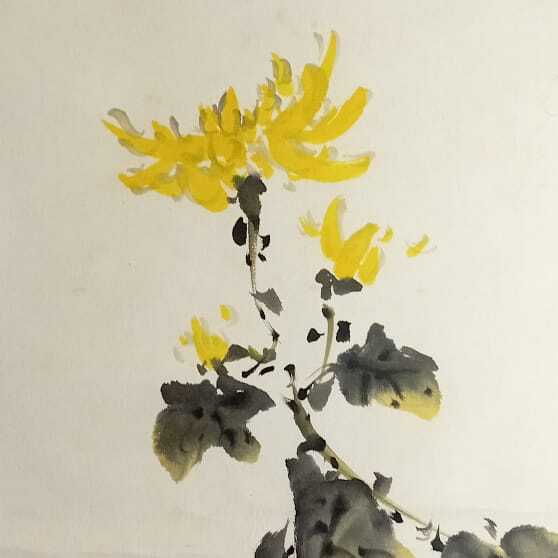
Toshio Suga / 須賀卯夫 1910–1992
Works on Shikishi
Toshio Suga was a Japanese modernist painter whose career developed from prewar figurative painting to geometric abstraction and the international avant-garde of the 1960s and 1970s.
Suga was active professionally by the mid-1930s. Archival records document his participation in the Tōkōkai exhibitions in 1935 and 1937 and in subsequent Ōshiokai exhibitions, establishing a substantial prewar career before the transformation of his work in the postwar period.
A decisive stage in Suga’s development was his connection with New York in the early 1960s. Worcester Art Museum holds his experimental Self Image of 1962, executed in sumi ink on telephone-directory paper. His work was also represented in the Museum of Modern Art’s Art Lending Service in New York in 1963. These years coincided with an increasingly experimental approach to materials, structure and abstraction.
In 1964 Suga exhibited Zō I and Zō II in Trends in Contemporary Art – Painting and Sculpture at the National Museum of Modern Art, Kyoto. The same year he became the driving force behind the formation of the New Geometric Art Group, established at his initiative while he was connected with New York.
Active from 1964 to 1974, the group explored geometric abstraction, visual perception and psychological order, developing in dialogue with international Op Art and related postwar movements. Suga also formulated its theoretical position in Bijutsu Techō in 1965, making him both an exhibiting artist and an important advocate for this direction in Japanese modern art.
The New Geometric Art Group exhibited in Japan and abroad, including presentations associated with New York’s Mi Chou Gallery. Suga continued exhibiting after the group’s dissolution, with a documented solo exhibition at Gallery Haku in 1981.
His surviving work ranges from early figurative painting and intimate New York drawings to geometric and optical abstraction. Suga occupies a distinctive position between prewar Japanese yōga and the internationally oriented modernism that reshaped Japanese art during the 1960s.
Suga was active professionally by the mid-1930s. Archival records document his participation in the Tōkōkai exhibitions in 1935 and 1937 and in subsequent Ōshiokai exhibitions, establishing a substantial prewar career before the transformation of his work in the postwar period.
A decisive stage in Suga’s development was his connection with New York in the early 1960s. Worcester Art Museum holds his experimental Self Image of 1962, executed in sumi ink on telephone-directory paper. His work was also represented in the Museum of Modern Art’s Art Lending Service in New York in 1963. These years coincided with an increasingly experimental approach to materials, structure and abstraction.
In 1964 Suga exhibited Zō I and Zō II in Trends in Contemporary Art – Painting and Sculpture at the National Museum of Modern Art, Kyoto. The same year he became the driving force behind the formation of the New Geometric Art Group, established at his initiative while he was connected with New York.
Active from 1964 to 1974, the group explored geometric abstraction, visual perception and psychological order, developing in dialogue with international Op Art and related postwar movements. Suga also formulated its theoretical position in Bijutsu Techō in 1965, making him both an exhibiting artist and an important advocate for this direction in Japanese modern art.
The New Geometric Art Group exhibited in Japan and abroad, including presentations associated with New York’s Mi Chou Gallery. Suga continued exhibiting after the group’s dissolution, with a documented solo exhibition at Gallery Haku in 1981.
His surviving work ranges from early figurative painting and intimate New York drawings to geometric and optical abstraction. Suga occupies a distinctive position between prewar Japanese yōga and the internationally oriented modernism that reshaped Japanese art during the 1960s.