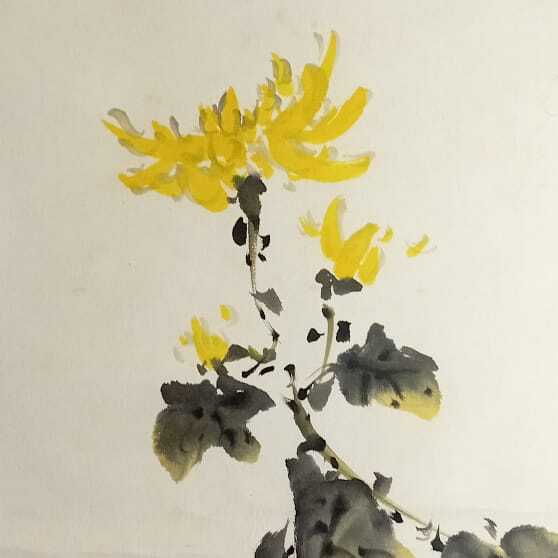
Shigeo Ishikawa / 石川茂男 1938–2010
Works on Shikishi
Shigeo Ishikawa was a Japanese yōga painter known for landscapes of rural Japan, particularly traditional villages, farmhouses, and mountain settlements. Born in Kanagawa Prefecture in 1938, he first exhibited with the Daiichi Bijutsu Kyōkai in 1958, when his work was accepted for the association’s exhibition. He later became a member and committee participant, receiving several awards during his involvement with the group.
From 1964 to 1965 Ishikawa travelled and worked in Europe. After returning to Japan, he held his first solo exhibition in 1966. In 1968 he travelled through Southeast Asia, producing sketches and later presenting works connected with these journeys. He left the Daiichi Bijutsu Kyōkai in 1972 and thereafter worked independently, holding numerous solo exhibitions.
The central subject of Ishikawa’s mature work became the traditional Japanese rural landscape. His paintings frequently depict old minka farmhouses and villages in specific regions of Japan, often identified by place name in their titles. In 1977 he appeared on NHK television in a feature titled “Minka no Gaka” (“Painter of Traditional Farmhouses”), a designation closely associated with his later reputation.
Ishikawa’s landscapes combine realistic observation with carefully constructed surface texture and an emphasis on the architecture and atmosphere of older rural Japan. His recorded subjects include areas such as Hakuba, Shirakawa-go, Tōno and other mountain and farming communities. Later in his career he also produced a substantial body of paintings of Mount Fuji.
In 1984 he donated the painting “Kakio Shūkei” to Kawasaki City, and in 1990 “Bōkyō” to Yokohama City. Documented later exhibitions include solo shows at Saikaya Kawasaki in 2003 and Tobu Department Store, Ikebukuro, in 2005. Ishikawa died in 2010 at the age of 71.
From 1964 to 1965 Ishikawa travelled and worked in Europe. After returning to Japan, he held his first solo exhibition in 1966. In 1968 he travelled through Southeast Asia, producing sketches and later presenting works connected with these journeys. He left the Daiichi Bijutsu Kyōkai in 1972 and thereafter worked independently, holding numerous solo exhibitions.
The central subject of Ishikawa’s mature work became the traditional Japanese rural landscape. His paintings frequently depict old minka farmhouses and villages in specific regions of Japan, often identified by place name in their titles. In 1977 he appeared on NHK television in a feature titled “Minka no Gaka” (“Painter of Traditional Farmhouses”), a designation closely associated with his later reputation.
Ishikawa’s landscapes combine realistic observation with carefully constructed surface texture and an emphasis on the architecture and atmosphere of older rural Japan. His recorded subjects include areas such as Hakuba, Shirakawa-go, Tōno and other mountain and farming communities. Later in his career he also produced a substantial body of paintings of Mount Fuji.
In 1984 he donated the painting “Kakio Shūkei” to Kawasaki City, and in 1990 “Bōkyō” to Yokohama City. Documented later exhibitions include solo shows at Saikaya Kawasaki in 2003 and Tobu Department Store, Ikebukuro, in 2005. Ishikawa died in 2010 at the age of 71.