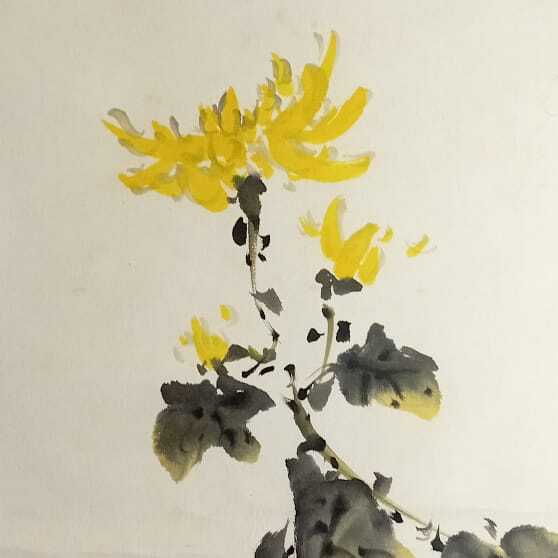
Serizawa Keisuke 芹沢銈介 1895–1984
Works on Shikishi
Serizawa Keisuke was one of the most important Japanese artists of stencil dyeing and printed design in the twentieth century. His name is closely associated with kataezome, a personal development of the Japanese stencil tradition in which drawing, cutting, resist, color, pattern, and text are brought together as a single artistic method. In 1956 he was designated a holder of an Important Intangible Cultural Property for kataezome, the status often described as a Living National Treasure of Japan.
Serizawa was born in Shizuoka into a family connected with the textile trade. He trained in industrial and applied design, and this background shaped the wide range of his later work. He created textiles, kimono, noren curtains, folding screens, book designs, calendars, decorated paper, posters, interior projects, and religious images.
A decisive influence on his artistic language came from Yanagi Soetsu and the mingei movement, which emphasized the value of folk craft, handwork, and functional beauty. Serizawa was also deeply affected by Okinawan bingata textiles, especially their bold color, flat decorative structure, and stencil-based technique. He did not simply copy folk models; he transformed them into a modern graphic language with a strong personal identity.
A key feature of Serizawa’s practice was the unity of all stages of production. In traditional workshops, the design, stencil cutting, and dyeing could be divided among different specialists. Serizawa sought to bring these processes under the control of the artist. For this reason his works are not merely decorative craft objects, but complete authored compositions in which image, ornament, and writing have equal importance.
Writing was central to his art. Letters and characters in his works retain their textual meaning, but also function as visual forms. This quality appears in his books, calendars, Buddhist subjects, and small works on paper.
After the Second World War, when cloth and dyes were difficult to obtain, Serizawa worked extensively with Japanese paper. In 1955 the Serizawa Dyeing Paper Institute was founded to produce and distribute small paper works, postcards, bookplates, decorative sheets, and related designs. This part of his output is an important counterpart to his large-scale textile works.
Serizawa received wide recognition in Japan and abroad. A major solo exhibition was held at the Grand Palais in Paris in 1976. His works are held by Japanese and international museums, including the Japan Folk Crafts Museum, the British Museum, the Metropolitan Museum of Art, Harvard Art Museums, and the dedicated Serizawa museums in Shizuoka and Sendai.
Serizawa’s legacy stands between craft, graphic art, textile design, and religious imagery. He turned a traditional stencil technique into a distinctive language of Japanese modernism while preserving a deep connection with folk culture and handmade form.
Serizawa was born in Shizuoka into a family connected with the textile trade. He trained in industrial and applied design, and this background shaped the wide range of his later work. He created textiles, kimono, noren curtains, folding screens, book designs, calendars, decorated paper, posters, interior projects, and religious images.
A decisive influence on his artistic language came from Yanagi Soetsu and the mingei movement, which emphasized the value of folk craft, handwork, and functional beauty. Serizawa was also deeply affected by Okinawan bingata textiles, especially their bold color, flat decorative structure, and stencil-based technique. He did not simply copy folk models; he transformed them into a modern graphic language with a strong personal identity.
A key feature of Serizawa’s practice was the unity of all stages of production. In traditional workshops, the design, stencil cutting, and dyeing could be divided among different specialists. Serizawa sought to bring these processes under the control of the artist. For this reason his works are not merely decorative craft objects, but complete authored compositions in which image, ornament, and writing have equal importance.
Writing was central to his art. Letters and characters in his works retain their textual meaning, but also function as visual forms. This quality appears in his books, calendars, Buddhist subjects, and small works on paper.
After the Second World War, when cloth and dyes were difficult to obtain, Serizawa worked extensively with Japanese paper. In 1955 the Serizawa Dyeing Paper Institute was founded to produce and distribute small paper works, postcards, bookplates, decorative sheets, and related designs. This part of his output is an important counterpart to his large-scale textile works.
Serizawa received wide recognition in Japan and abroad. A major solo exhibition was held at the Grand Palais in Paris in 1976. His works are held by Japanese and international museums, including the Japan Folk Crafts Museum, the British Museum, the Metropolitan Museum of Art, Harvard Art Museums, and the dedicated Serizawa museums in Shizuoka and Sendai.
Serizawa’s legacy stands between craft, graphic art, textile design, and religious imagery. He turned a traditional stencil technique into a distinctive language of Japanese modernism while preserving a deep connection with folk culture and handmade form.