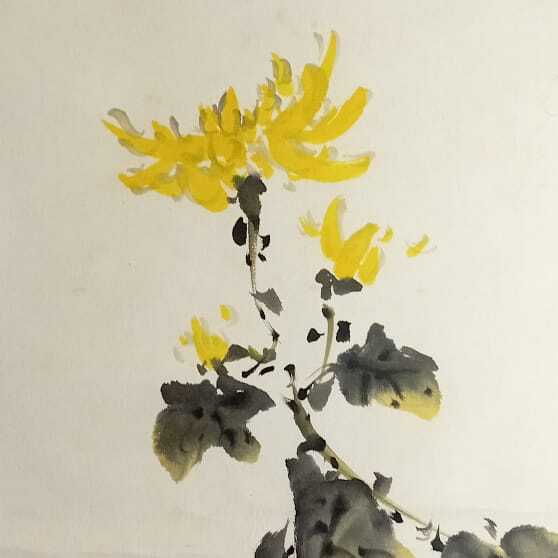
Osawa Hisashi / 大澤一佐志 (born 1928)
Works on Shikishi
Osawa Hisashi is a Japanese artist and calligrapher associated with the postwar art scene of Gifu Prefecture and with a practice in which writing, image, and poetic text are treated as a single work.
He was born in 1928 in Miyama, Yamagata District, Gifu Prefecture. He first studied calligraphy. In 1954, he received a newcomer award at the Bokujin exhibition at the Kyoto Municipal Museum of Art, linking his early practice to the circle of postwar avant-garde calligraphy, where the written sign was no longer only script but also an independent visual form.
In the 1950s, Osawa’s works were shown in exhibitions of contemporary Japanese calligraphy outside Japan, including presentations in New York, Paris, and Brussels. Later, while preserving a connection with the East Asian tradition of writing, he moved into the field of painting and worked outside strict affiliation with major art organizations.
In the early 1960s, Osawa was recognized within the contemporary exhibition system: he received a Shell Art Award, exhibited at the Contemporary Art Exhibition of Japan at the Tokyo Metropolitan Art Museum, was selected among Mizue Award artists, and took part in the International Exhibition of Young Artists in Paris. His solo and group exhibitions were held in Tokyo, Aichi, and Gifu.
A central place in his work is occupied by kuga, a form combining haiku, calligraphy, and image. In the 1970s, he held exhibitions directly devoted to this field, including Kuga in Ink, The Meeting of Words and Images, and a project on drawing as a form of abstract poetry. In such works, shikishi is not simply a small decorative format, but an intimate field where word, sign, and image interact.
In 1977, Osawa visited Florence as a goodwill envoy of the UNESCO Association and later presented works connected with this journey in exhibitions in Florence and Gifu. In 1983, he became one of the founders of the Gifu Contemporary Artists Association together with Nishio Ichizo and Ando Isao. His name also appears in the exhibition history of Gifu art, confirming his place in the regional and postwar Japanese art context.
He was born in 1928 in Miyama, Yamagata District, Gifu Prefecture. He first studied calligraphy. In 1954, he received a newcomer award at the Bokujin exhibition at the Kyoto Municipal Museum of Art, linking his early practice to the circle of postwar avant-garde calligraphy, where the written sign was no longer only script but also an independent visual form.
In the 1950s, Osawa’s works were shown in exhibitions of contemporary Japanese calligraphy outside Japan, including presentations in New York, Paris, and Brussels. Later, while preserving a connection with the East Asian tradition of writing, he moved into the field of painting and worked outside strict affiliation with major art organizations.
In the early 1960s, Osawa was recognized within the contemporary exhibition system: he received a Shell Art Award, exhibited at the Contemporary Art Exhibition of Japan at the Tokyo Metropolitan Art Museum, was selected among Mizue Award artists, and took part in the International Exhibition of Young Artists in Paris. His solo and group exhibitions were held in Tokyo, Aichi, and Gifu.
A central place in his work is occupied by kuga, a form combining haiku, calligraphy, and image. In the 1970s, he held exhibitions directly devoted to this field, including Kuga in Ink, The Meeting of Words and Images, and a project on drawing as a form of abstract poetry. In such works, shikishi is not simply a small decorative format, but an intimate field where word, sign, and image interact.
In 1977, Osawa visited Florence as a goodwill envoy of the UNESCO Association and later presented works connected with this journey in exhibitions in Florence and Gifu. In 1983, he became one of the founders of the Gifu Contemporary Artists Association together with Nishio Ichizo and Ando Isao. His name also appears in the exhibition history of Gifu art, confirming his place in the regional and postwar Japanese art context.