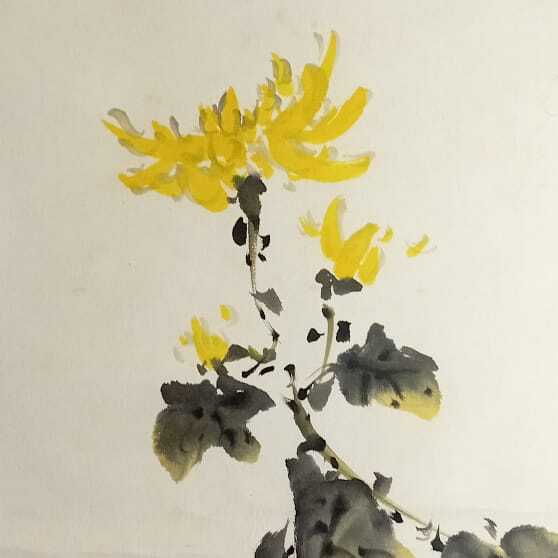
Nishigaki Fukou / 西垣風江 (1917 - 2005)
Works on Shikishi
Nishigaki Fukou was a Japanese nihonga painter from Iwami, Tottori Prefecture. In Japanese museum materials, his name is read and romanized as Nishigaki Fukou. His work is closely connected with postwar Japanese painting and with the regional culture of Tottori: local landscapes, folklore, festivals, and the cultural memory of Inaba.
From 1932 to 1937, Fukou studied under Kobayakawa Shusei, an important nihonga painter associated with the artistic world of Tottori. From 1938 to 1945, he worked as a pattern designer for Kyoto textiles. This background is relevant to his mature work, where regional subjects often appear through a clear decorative structure and a strong connection to folk forms, signs, and local visual traditions.
Fukou’s exhibition history included works accepted for the Marine Art Exhibition, the Greater East Asia War Art Exhibition, the Shin Nihon Bijutsu Exhibition, the Sozo Bijutsu Exhibition, and the Shinseisaku Association Exhibition. These stages place him within the transition from prewar and wartime exhibition systems to the postwar renewal of nihonga. His later connection with Sogakai belongs to this same institutional line of modern Japanese painting.
After the war, Fukou devoted himself fully to nihonga and developed an individual artistic line based on the imagery of his native region. Japanese prefectural sources describe him as an artist who created works based on local folklore and the landscapes of Tottori, often using red and black as important structural colors. Regional culture was not a decorative accessory for Fukou, but one of the central foundations of his painting.
Nishigaki Fukou held an established position in the artistic life of Tottori. From 1955, he served as a judge for city exhibitions, and from 1955 to 1995 he served as a judge for prefectural exhibitions in Tottori. This shows him not only as an exhibiting artist, but also as a figure of professional authority within the regional nihonga system.
In 2004, Nishigaki Fukou received the Tottori Prefecture Cultural Merit Award for Japanese painting. His works are recorded in the collection and exhibition materials of the Tottori Prefectural Museum / Tottori Prefectural Museum of Art, including works connected with the Tottori Sand Dunes and regional folklore.
Fukou’s later works on shikishi may be understood as a compact format of the same artistic direction: modern nihonga connected with memory of place, folk imagery, festival culture, and the visual traditions of Tottori and Inaba.
From 1932 to 1937, Fukou studied under Kobayakawa Shusei, an important nihonga painter associated with the artistic world of Tottori. From 1938 to 1945, he worked as a pattern designer for Kyoto textiles. This background is relevant to his mature work, where regional subjects often appear through a clear decorative structure and a strong connection to folk forms, signs, and local visual traditions.
Fukou’s exhibition history included works accepted for the Marine Art Exhibition, the Greater East Asia War Art Exhibition, the Shin Nihon Bijutsu Exhibition, the Sozo Bijutsu Exhibition, and the Shinseisaku Association Exhibition. These stages place him within the transition from prewar and wartime exhibition systems to the postwar renewal of nihonga. His later connection with Sogakai belongs to this same institutional line of modern Japanese painting.
After the war, Fukou devoted himself fully to nihonga and developed an individual artistic line based on the imagery of his native region. Japanese prefectural sources describe him as an artist who created works based on local folklore and the landscapes of Tottori, often using red and black as important structural colors. Regional culture was not a decorative accessory for Fukou, but one of the central foundations of his painting.
Nishigaki Fukou held an established position in the artistic life of Tottori. From 1955, he served as a judge for city exhibitions, and from 1955 to 1995 he served as a judge for prefectural exhibitions in Tottori. This shows him not only as an exhibiting artist, but also as a figure of professional authority within the regional nihonga system.
In 2004, Nishigaki Fukou received the Tottori Prefecture Cultural Merit Award for Japanese painting. His works are recorded in the collection and exhibition materials of the Tottori Prefectural Museum / Tottori Prefectural Museum of Art, including works connected with the Tottori Sand Dunes and regional folklore.
Fukou’s later works on shikishi may be understood as a compact format of the same artistic direction: modern nihonga connected with memory of place, folk imagery, festival culture, and the visual traditions of Tottori and Inaba.