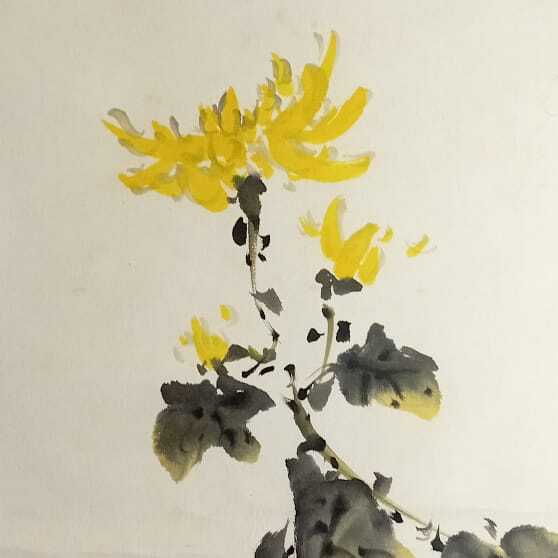
Nagata Kōi / 永田耕衣 1900–1997
Works on Shikishi
Nagata Kōi was a Japanese haiku poet, theorist, calligrapher, and ink painter, and one of the most distinctive figures of the postwar literary avant-garde. Born in Onoe, Hyōgo Prefecture, he began writing haiku around 1920 while pursuing a long professional career at Mitsubishi Paper in Takasago. His early development was shaped by several major haiku circles, including Tsuru, Tenrō, and the Modern Haiku Association. In 1949 he founded the journal Riraza, which became the principal platform for his independent poetics.
Kōi developed the concept of kongen haiku, or “root haiku,” grounding poetry in Zen thought, human existence, ageing, death, bodily experience, and the idea of “Eastern nothingness.” His work preserved the compression of traditional haiku while introducing paradox, linguistic disruption, philosophical intensity, and dark humour. This approach placed him close to the experimental currents of postwar haiku and established his reputation beyond literary circles.
His artistic network included poets Saitō Sanki, Yamaguchi Seishi, Akao Tōshi, Kaneko Tōta, and Takayanagi Shigenobu, as well as artists and crafts figures such as Munakata Shikō, Kawai Kanjirō, and Suda Kokuta. Through these relationships, Kōi’s practice developed at the intersection of modern poetry, Zen, the mingei movement, calligraphy, and experimental art.
Calligraphy and ink painting formed a substantial part of his career. Kōi worked with his own poems, Zen sayings, Buddhist texts, and classical sources, transforming written language into dense visual compositions. From the 1960s onward he presented calligraphic works in dedicated exhibitions, and later publications documented a broad body of calligraphy and painting. His writing was recognised for its radical individuality and attracted attention from professional calligraphers as well as poets and visual artists.
Kōi received the Kobe City Cultural Award, the Hyōgo Prefecture Cultural Award, the Grand Prize of the Modern Haiku Association, and the Museum of Contemporary Japanese Poetry, Tanka and Haiku Award for his collection Doron. After the 1995 Great Hanshin-Awaji Earthquake destroyed his home in Kobe, more than 5,000 manuscripts, letters, calligraphic works, paintings, and collected objects were recovered. This archive is now preserved by the Himeji City Museum of Literature and remains central to the study of his work.
Nagata Kōi occupies a distinctive position in twentieth-century Japanese culture as a poet-philosopher whose calligraphy, haiku, and Zen thought developed as a unified artistic practice.
Kōi developed the concept of kongen haiku, or “root haiku,” grounding poetry in Zen thought, human existence, ageing, death, bodily experience, and the idea of “Eastern nothingness.” His work preserved the compression of traditional haiku while introducing paradox, linguistic disruption, philosophical intensity, and dark humour. This approach placed him close to the experimental currents of postwar haiku and established his reputation beyond literary circles.
His artistic network included poets Saitō Sanki, Yamaguchi Seishi, Akao Tōshi, Kaneko Tōta, and Takayanagi Shigenobu, as well as artists and crafts figures such as Munakata Shikō, Kawai Kanjirō, and Suda Kokuta. Through these relationships, Kōi’s practice developed at the intersection of modern poetry, Zen, the mingei movement, calligraphy, and experimental art.
Calligraphy and ink painting formed a substantial part of his career. Kōi worked with his own poems, Zen sayings, Buddhist texts, and classical sources, transforming written language into dense visual compositions. From the 1960s onward he presented calligraphic works in dedicated exhibitions, and later publications documented a broad body of calligraphy and painting. His writing was recognised for its radical individuality and attracted attention from professional calligraphers as well as poets and visual artists.
Kōi received the Kobe City Cultural Award, the Hyōgo Prefecture Cultural Award, the Grand Prize of the Modern Haiku Association, and the Museum of Contemporary Japanese Poetry, Tanka and Haiku Award for his collection Doron. After the 1995 Great Hanshin-Awaji Earthquake destroyed his home in Kobe, more than 5,000 manuscripts, letters, calligraphic works, paintings, and collected objects were recovered. This archive is now preserved by the Himeji City Museum of Literature and remains central to the study of his work.
Nagata Kōi occupies a distinctive position in twentieth-century Japanese culture as a poet-philosopher whose calligraphy, haiku, and Zen thought developed as a unified artistic practice.