Mushakōji Saneatsu / 武者小路実篤 (1885–1976)
Works on Shikishi
Mushakōji Saneatsu was one of the central figures of Japanese culture in the Taishō and Shōwa periods: a novelist, playwright, poet, essayist, art critic, social thinker, and artist. Born into an aristocratic family in Tokyo, he studied at Gakushūin, where he formed a close friendship with the writer Shiga Naoya. In 1910, together with Shiga, Arishima Takeo, Yanagi Sōetsu, and other writers and artists, he founded the journal Shirakaba. The group promoted individual dignity, creative freedom, and humanist ideals, while also introducing Japanese readers to modern European art, especially Rodin, Van Gogh, and Cézanne.
In 1918, Mushakōji founded Atarashiki Mura, or “The New Village,” an experimental community based on shared labour, mutual support, and the pursuit of intellectual and artistic development. He remained connected with the movement throughout his life.
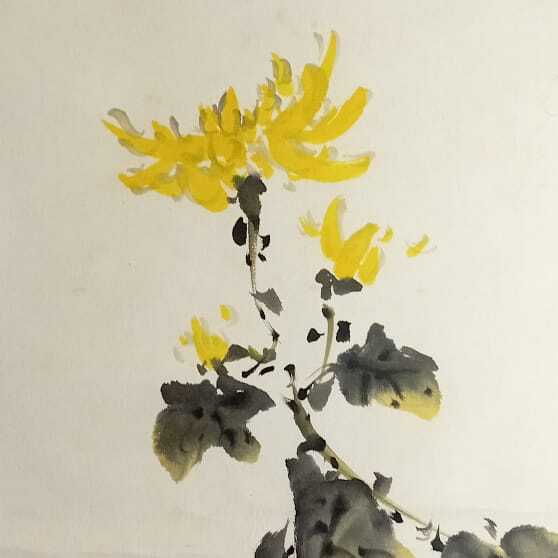
Mushakōji began painting systematically in the 1920s and held his first solo exhibition in 1929. His most recognisable works combine simple subjects such as flowers, vegetables, fruit, ceramics, and small landscapes with brief philosophical or ethical inscriptions. His visual art extended the same ideas found in his writing: affirmation of life, friendship, inner independence, and human dignity. He worked in ink and colour, drawing, oil painting, and calligraphy, and also produced small-format works on shikishi.
After the Second World War, Mushakōji exhibited regularly and gained broad recognition as both a writer and an artist. He received the Order of Culture in 1951 and was named an honorary citizen of Tokyo in 1965. His legacy is preserved by the Chofu City Mushakoji Saneatsu Memorial Museum, opened in 1985 beside his former residence. Its holdings include manuscripts, paintings, calligraphy, books, personal materials, and works from his art collection.
Within modern Japanese art, Mushakōji occupies a distinctive position as a writer-artist for whom image and text formed a single statement. His paintings are closely connected with the Shirakaba movement, the ideals of Atarashiki Mura, and the belief that art could support both personal and social development.
In 1918, Mushakōji founded Atarashiki Mura, or “The New Village,” an experimental community based on shared labour, mutual support, and the pursuit of intellectual and artistic development. He remained connected with the movement throughout his life.
Mushakōji began painting systematically in the 1920s and held his first solo exhibition in 1929. His most recognisable works combine simple subjects such as flowers, vegetables, fruit, ceramics, and small landscapes with brief philosophical or ethical inscriptions. His visual art extended the same ideas found in his writing: affirmation of life, friendship, inner independence, and human dignity. He worked in ink and colour, drawing, oil painting, and calligraphy, and also produced small-format works on shikishi.
After the Second World War, Mushakōji exhibited regularly and gained broad recognition as both a writer and an artist. He received the Order of Culture in 1951 and was named an honorary citizen of Tokyo in 1965. His legacy is preserved by the Chofu City Mushakoji Saneatsu Memorial Museum, opened in 1985 beside his former residence. Its holdings include manuscripts, paintings, calligraphy, books, personal materials, and works from his art collection.
Within modern Japanese art, Mushakōji occupies a distinctive position as a writer-artist for whom image and text formed a single statement. His paintings are closely connected with the Shirakaba movement, the ideals of Atarashiki Mura, and the belief that art could support both personal and social development.