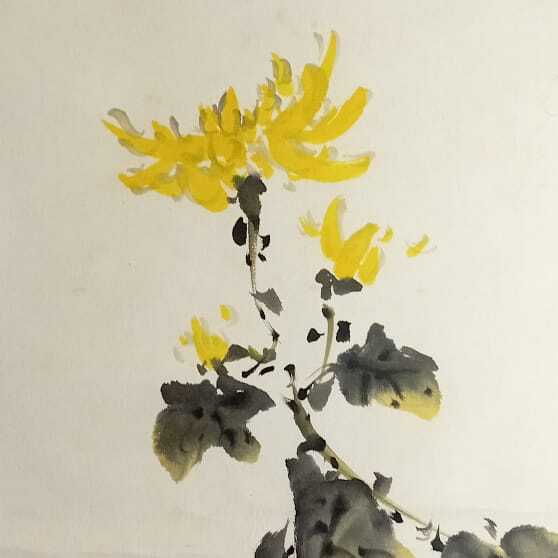
Motofuji Yoshiharu / 本藤好春 born 1926
Works on Shikishi
Motofuji Yoshiharu was a Japanese yōga painter — an artist working in Western-style painting within the Japanese artistic context. He was born in 1926 in Iyo, Ehime Prefecture, and was closely connected with the artistic life of Ehime and Shikoku.
After the war, Motofuji entered the local art community and studied under Professor Fujitani of Ehime University. His professional career developed through the prefectural exhibition system, regional art societies, and national juried exhibitions. He exhibited at the Ehime Prefectural Art Exhibition and with Sogen-kai, received four awards at the prefectural exhibition, and was later admitted as a member of Sogen-kai.
A central theme in his work was Awa Odori, the famous dance festival of Tokushima. According to the artist’s biographical materials, six of his works were accepted for consecutive Nitten exhibitions, and all of them were devoted to Awa Odori. This subject became one of the most recognizable lines in his art: the festive movement, processional rhythm, and collective energy of the dance connected the regional culture of Shikoku with the language of modern Japanese yōga painting.
Motofuji Yoshiharu was not only an exhibiting artist but also an active figure in the artistic infrastructure of his region. In 1974, he took part in the establishment of the Iyo City Art Association and later served as its president. He also held positions within the prefectural exhibition system, led art groups, and taught painting.
His exhibition activity continued into the later period of his life. In 1987, a solo exhibition of his work was held at Gallery Platane in Matsuyama, accompanied by a printed exhibition postcard with a biographical note. In the 2000s, he continued to exhibit and teach; his activity is documented at least as late as 2010.
Motofuji Yoshiharu’s standing within the Ehime art community is reflected in the memorial prize established in his name in the Western painting section of the prefectural exhibition. His work represents a regional line of postwar Japanese yōga painting, where local culture, the exhibition system, and a sustained personal subject came together in a distinctive artistic identity.
After the war, Motofuji entered the local art community and studied under Professor Fujitani of Ehime University. His professional career developed through the prefectural exhibition system, regional art societies, and national juried exhibitions. He exhibited at the Ehime Prefectural Art Exhibition and with Sogen-kai, received four awards at the prefectural exhibition, and was later admitted as a member of Sogen-kai.
A central theme in his work was Awa Odori, the famous dance festival of Tokushima. According to the artist’s biographical materials, six of his works were accepted for consecutive Nitten exhibitions, and all of them were devoted to Awa Odori. This subject became one of the most recognizable lines in his art: the festive movement, processional rhythm, and collective energy of the dance connected the regional culture of Shikoku with the language of modern Japanese yōga painting.
Motofuji Yoshiharu was not only an exhibiting artist but also an active figure in the artistic infrastructure of his region. In 1974, he took part in the establishment of the Iyo City Art Association and later served as its president. He also held positions within the prefectural exhibition system, led art groups, and taught painting.
His exhibition activity continued into the later period of his life. In 1987, a solo exhibition of his work was held at Gallery Platane in Matsuyama, accompanied by a printed exhibition postcard with a biographical note. In the 2000s, he continued to exhibit and teach; his activity is documented at least as late as 2010.
Motofuji Yoshiharu’s standing within the Ehime art community is reflected in the memorial prize established in his name in the Western painting section of the prefectural exhibition. His work represents a regional line of postwar Japanese yōga painting, where local culture, the exhibition system, and a sustained personal subject came together in a distinctive artistic identity.