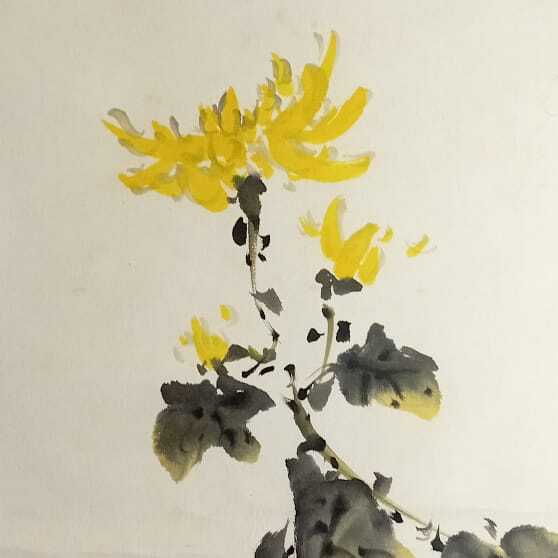
Mizuta Kenzan 水田硯山 1902–1988
Works on Shikishi
Mizuta Kenzan was a Japanese nanga painter associated with the Kyoto art world of the Taishō and Shōwa periods. He was born in Osaka on December 14, 1902, under the name Mizuta Yoshirō. His elder brother, the established nanga artist Mizuta Chikuho, became his first teacher. Kenzan also studied the Chinese classics under the Confucian scholar Fujisawa Nangaku, combining formal painting instruction with the literary culture central to the nanga tradition.
He moved to Kyoto in 1918 and was first accepted into the Japan Nanga Academy exhibition in 1921 with Clouds Coming and Going. In 1922 he became a regular member of the academy. That same year, at the age of nineteen, Two Autumn Subjects received a Special Selection Award at the 4th Teiten, the Imperial Art Exhibition. A journey to China in 1923 provided material for a new group of landscapes based on direct observation and classical Chinese imagery.
Kenzan received two further Teiten Special Selection Awards: in 1925 for Scattered Clouds and High Water, and in 1927 for Morning. Following the 1928 exhibition, he gained the status of an artist admitted without preliminary jury review and continued to exhibit at Teiten, Shin-Bunten, and other major state exhibitions. In 1939 he took part in founding the Kyoto-based Nanchōsha group, and in 1941 he joined the committee of a new association devoted to the Southern School tradition.
Mountain landscape remained the central subject of Kenzan’s art. His work developed nanga through dense spatial construction, rhythmic brushwork, and an engagement with European Post-Impressionism. Chinese literary imagery, close observation of nature, and a modern treatment of color and form shaped his mature style. His classical education also informed his calligraphy, where large cursive forms and carefully selected seals became integral to the composition.
After the war, Kenzan participated in the Nitten exhibitions as an invited artist. In 1958 he founded the Seiseisha art group. In 1960 he helped re-establish the Japan Nanga Academy and joined its board. His painting Tree received the Academy Prize that year, followed by the Minister of Education Award for Autumn in 1961. He later served as auditor and adviser to the academy. From the mid-1970s, declining eyesight gradually limited his activity. He died in Kyoto on September 7, 1988.
Works by Mizuta Kenzan are held by the National Museum of Modern Art, Tokyo, the Nakanoshima Museum of Art, Osaka, and other Japanese collections. Important museum works include Morning Mist Clearing, 1926; Green Slopes of Dorokyō Gorge, 1927; and Waterfall among Layered Cliffs, 1942.
He moved to Kyoto in 1918 and was first accepted into the Japan Nanga Academy exhibition in 1921 with Clouds Coming and Going. In 1922 he became a regular member of the academy. That same year, at the age of nineteen, Two Autumn Subjects received a Special Selection Award at the 4th Teiten, the Imperial Art Exhibition. A journey to China in 1923 provided material for a new group of landscapes based on direct observation and classical Chinese imagery.
Kenzan received two further Teiten Special Selection Awards: in 1925 for Scattered Clouds and High Water, and in 1927 for Morning. Following the 1928 exhibition, he gained the status of an artist admitted without preliminary jury review and continued to exhibit at Teiten, Shin-Bunten, and other major state exhibitions. In 1939 he took part in founding the Kyoto-based Nanchōsha group, and in 1941 he joined the committee of a new association devoted to the Southern School tradition.
Mountain landscape remained the central subject of Kenzan’s art. His work developed nanga through dense spatial construction, rhythmic brushwork, and an engagement with European Post-Impressionism. Chinese literary imagery, close observation of nature, and a modern treatment of color and form shaped his mature style. His classical education also informed his calligraphy, where large cursive forms and carefully selected seals became integral to the composition.
After the war, Kenzan participated in the Nitten exhibitions as an invited artist. In 1958 he founded the Seiseisha art group. In 1960 he helped re-establish the Japan Nanga Academy and joined its board. His painting Tree received the Academy Prize that year, followed by the Minister of Education Award for Autumn in 1961. He later served as auditor and adviser to the academy. From the mid-1970s, declining eyesight gradually limited his activity. He died in Kyoto on September 7, 1988.
Works by Mizuta Kenzan are held by the National Museum of Modern Art, Tokyo, the Nakanoshima Museum of Art, Osaka, and other Japanese collections. Important museum works include Morning Mist Clearing, 1926; Green Slopes of Dorokyō Gorge, 1927; and Waterfall among Layered Cliffs, 1942.