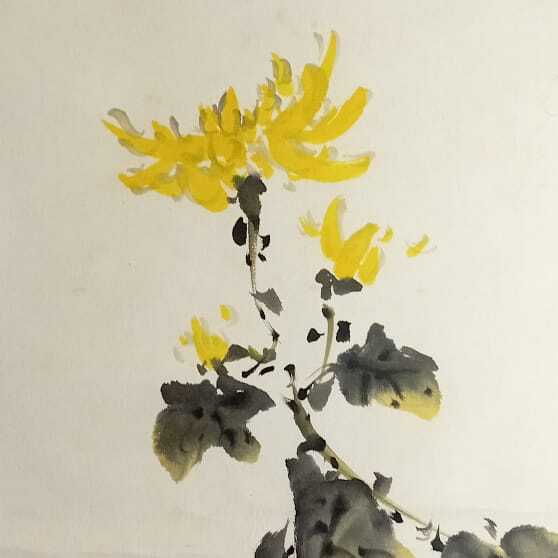
Masao Nakada / 中田政夫 1905–1980
Works on Shikishi
Masao Nakada was a Japanese painter, illustrator and designer whose career was closely connected with Okayama. Born in Marunouchi, Okayama, he studied Western-style painting at the Kawabata Art School in Tokyo and, after returning home, trained under the local yōga painter Kobayashi Kiichirō. In 1933, he became the first artist from Okayama accepted to the 11th Shun’yōkai exhibition and continued to exhibit with the society.
In 1939, Nakada travelled in China to make landscape studies and later held a solo exhibition of North China subjects in Okayama. During the final years of the war, he worked at the Mitsubishi Mizushima Aircraft Works. His home was destroyed in the bombing of Okayama, but some art materials survived because they had been buried for safekeeping. In February 1946, he used them to create twenty dated watercolor sketches recording the ruined city, its black markets, occupation troops and early recovery. The complete series was first shown in Okayama in 1985 and was presented by the Okayama City Museum in 2020.
After the war, Nakada also worked in sumi-e and produced subjects connected with Bitchū Kagura. His wider practice included book and editorial illustration, logos and packaging for Okayama businesses. In 1965, he illustrated Okayama no tori, a book on the birds of the prefecture.
Nakada also designed painted clay folk figures for the family workshop Kimi Kōgeisha. Beginning with the Uwahan dolls in 1956, his designs drew on Okayama legends, dances and folk performance. These works belong broadly to kyōdo gangu, Japanese local folk toys, and more precisely to postwar sōsei gangu: newly created folk toys rooted in regional culture.
The 2024 research and exhibition project Design Works by Masao Nakada, organized by Toy Kogeisha with the cooperation of the artist’s family, brought together around one hundred paintings, printed materials, package designs and folk toys. It re-established Nakada as a versatile twentieth-century artist whose yōga painting, documentary sketches, applied graphics and folk-toy designs formed a coherent contribution to the visual culture of Okayama.
In 1939, Nakada travelled in China to make landscape studies and later held a solo exhibition of North China subjects in Okayama. During the final years of the war, he worked at the Mitsubishi Mizushima Aircraft Works. His home was destroyed in the bombing of Okayama, but some art materials survived because they had been buried for safekeeping. In February 1946, he used them to create twenty dated watercolor sketches recording the ruined city, its black markets, occupation troops and early recovery. The complete series was first shown in Okayama in 1985 and was presented by the Okayama City Museum in 2020.
After the war, Nakada also worked in sumi-e and produced subjects connected with Bitchū Kagura. His wider practice included book and editorial illustration, logos and packaging for Okayama businesses. In 1965, he illustrated Okayama no tori, a book on the birds of the prefecture.
Nakada also designed painted clay folk figures for the family workshop Kimi Kōgeisha. Beginning with the Uwahan dolls in 1956, his designs drew on Okayama legends, dances and folk performance. These works belong broadly to kyōdo gangu, Japanese local folk toys, and more precisely to postwar sōsei gangu: newly created folk toys rooted in regional culture.
The 2024 research and exhibition project Design Works by Masao Nakada, organized by Toy Kogeisha with the cooperation of the artist’s family, brought together around one hundred paintings, printed materials, package designs and folk toys. It re-established Nakada as a versatile twentieth-century artist whose yōga painting, documentary sketches, applied graphics and folk-toy designs formed a coherent contribution to the visual culture of Okayama.