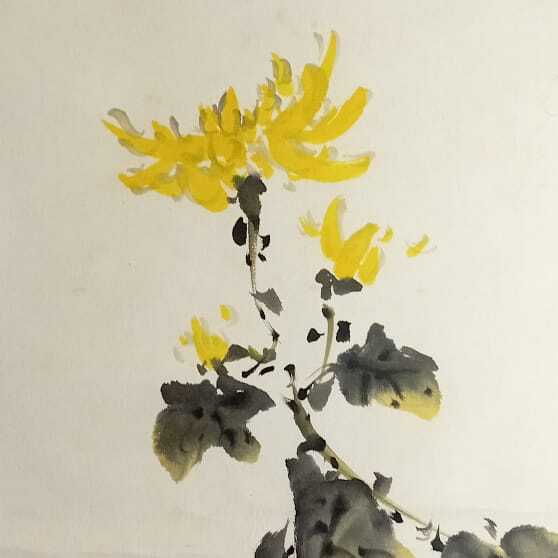
Koyatsu Masami / 小谷津雅美 1937–2011
Works on Shikishi
Koyatsu Masami was a Japanese nihonga painter associated with the Nihon Bijutsuin and its Inten exhibition system. He belonged to the postwar generation of artists who continued the academic tradition of 20th-century Japanese painting while working within the changing artistic environment of the second half of the century.
Koyatsu was born into a family closely connected with nihonga. His father, Koyatsu Ningyū, was also a painter and a member of the Nihon Bijutsuin. From an early age, Masami was part of a professional artistic milieu. In 1953, his work was accepted for the Inten exhibition for the first time, marking the beginning of his long involvement with the Nihon Bijutsuin. From 1955, he studied under Yasuda Yukihiko, one of the leading masters of 20th-century Japanese painting and an important figure in historically and classically oriented nihonga.
Koyatsu Masami’s career developed through regular participation in the Inten and the spring exhibitions of the Nihon Bijutsuin. In the 1960s, he received several exhibition awards and distinctions within the Academy. In 1964, he was granted tokutai status, and in 1998 he was elected dōjin, a full member of the Nihon Bijutsuin. This status placed him within the core professional circle of the institution rather than merely among its regular exhibitors.
Across different periods of his career, Koyatsu worked with female figures, Buddhist imagery, temple sculpture, seasonal nature, birds, flowers, and animals. In the 1980s and 1990s, Japanese landscape, natural cycles, and traditional visual culture became especially important in his work. His major exhibition paintings remained closely connected with academic nihonga and the exhibition tradition of the Nihon Bijutsuin.
Koyatsu Masami later received major national awards, including the Minister of Education, Culture, Sports, Science and Technology Award and the Prime Minister’s Award. His works are held in Japanese museum collections, including the Hiratsuka Museum of Art, the Museum of Modern Art, Ibaraki, and other public collections.
Koyatsu was born into a family closely connected with nihonga. His father, Koyatsu Ningyū, was also a painter and a member of the Nihon Bijutsuin. From an early age, Masami was part of a professional artistic milieu. In 1953, his work was accepted for the Inten exhibition for the first time, marking the beginning of his long involvement with the Nihon Bijutsuin. From 1955, he studied under Yasuda Yukihiko, one of the leading masters of 20th-century Japanese painting and an important figure in historically and classically oriented nihonga.
Koyatsu Masami’s career developed through regular participation in the Inten and the spring exhibitions of the Nihon Bijutsuin. In the 1960s, he received several exhibition awards and distinctions within the Academy. In 1964, he was granted tokutai status, and in 1998 he was elected dōjin, a full member of the Nihon Bijutsuin. This status placed him within the core professional circle of the institution rather than merely among its regular exhibitors.
Across different periods of his career, Koyatsu worked with female figures, Buddhist imagery, temple sculpture, seasonal nature, birds, flowers, and animals. In the 1980s and 1990s, Japanese landscape, natural cycles, and traditional visual culture became especially important in his work. His major exhibition paintings remained closely connected with academic nihonga and the exhibition tradition of the Nihon Bijutsuin.
Koyatsu Masami later received major national awards, including the Minister of Education, Culture, Sports, Science and Technology Award and the Prime Minister’s Award. His works are held in Japanese museum collections, including the Hiratsuka Museum of Art, the Museum of Modern Art, Ibaraki, and other public collections.