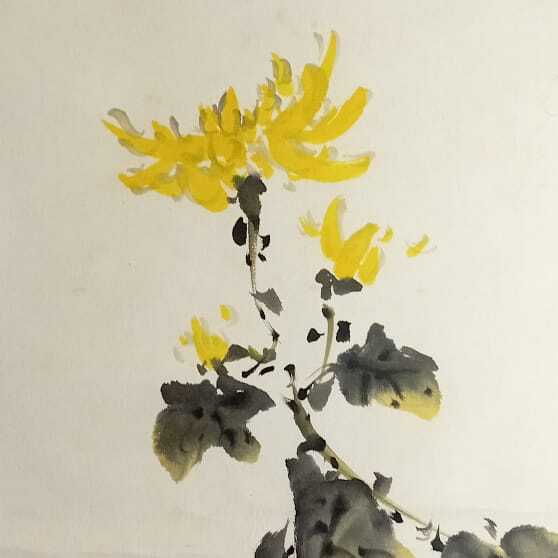
Kinbara Teruya / 金原テル也 1933–2018
Works on Shikishi
Kinbara Teruya was a Japanese yōga painter associated with Aichi Prefecture and the artistic culture of the Chubu region. He worked within the tradition of Western-style painting in Japan and was closely connected with Niki-kai, one of the important postwar associations of Japanese painters. In 1959, his work was first accepted for the 13th Niki Exhibition, marking the beginning of a long exhibition career within the association.
Kinbara later gained a notable position in Niki-kai. He received the Miyamoto Prize in 1992, was appointed to the association’s committee in 1996, received the Kuroda Prize in 2001, and later served as head of the Chubu regional branch of Niki-kai. These facts place him firmly within the professional exhibition system of postwar Japanese yōga painting.
His large exhibition works often combined figurative motifs, personal memories, and symbolic imagery. In an artist’s comment on one of his works, Kinbara referred to ideas such as floating, light and shadow, wind, and a phantom tower. This gives a useful key to his mature painting: recognizable objects in his work often become images of memory, dream, or inner space.
Alongside his larger compositions, Kinbara also turned to landscape and to specific places in Japan. He was connected with artistic projects in the Chubu region, including the Landscape Society, where artists from different groups worked with selected sites and themes. This landscape-oriented part of his practice also gives context to more intimate formats such as shikishi, where a particular place can be presented with documentary clarity while still remaining part of the artist’s personal vision.
One of his landscapes, Cherry Trees along the Otowa River from 1999, is held in the collection of the Sakuragaoka Museum in Toyokawa. In 2021, the Seto City Art Museum held a retrospective exhibition dedicated to Kinbara Teruya, presenting works from roughly thirty years of his career, including prize-winning paintings and his final work. His position is best understood as that of a recognized professional painter of Aichi Prefecture, closely linked to Niki-kai and to the postwar artistic culture of the Chubu region.
Kinbara later gained a notable position in Niki-kai. He received the Miyamoto Prize in 1992, was appointed to the association’s committee in 1996, received the Kuroda Prize in 2001, and later served as head of the Chubu regional branch of Niki-kai. These facts place him firmly within the professional exhibition system of postwar Japanese yōga painting.
His large exhibition works often combined figurative motifs, personal memories, and symbolic imagery. In an artist’s comment on one of his works, Kinbara referred to ideas such as floating, light and shadow, wind, and a phantom tower. This gives a useful key to his mature painting: recognizable objects in his work often become images of memory, dream, or inner space.
Alongside his larger compositions, Kinbara also turned to landscape and to specific places in Japan. He was connected with artistic projects in the Chubu region, including the Landscape Society, where artists from different groups worked with selected sites and themes. This landscape-oriented part of his practice also gives context to more intimate formats such as shikishi, where a particular place can be presented with documentary clarity while still remaining part of the artist’s personal vision.
One of his landscapes, Cherry Trees along the Otowa River from 1999, is held in the collection of the Sakuragaoka Museum in Toyokawa. In 2021, the Seto City Art Museum held a retrospective exhibition dedicated to Kinbara Teruya, presenting works from roughly thirty years of his career, including prize-winning paintings and his final work. His position is best understood as that of a recognized professional painter of Aichi Prefecture, closely linked to Niki-kai and to the postwar artistic culture of the Chubu region.