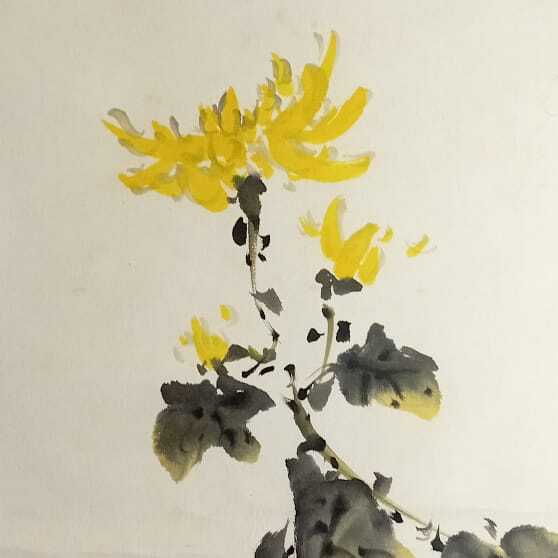
Kawakami Setsui / 川上拙以 (1901–1976)
Works on Shikishi
Kawakami Setsui was a Japanese nihonga painter associated with the Kyoto art world of the twentieth century. He was born in Ehime Prefecture and received professional artistic training at the Kyoto Municipal Special School of Painting, later incorporated into Kyoto City University of Arts.
Setsui first studied under Suga Tatehiko and later became a pupil of Nishiyama Suisho, one of the important Kyoto nihonga masters of the first half of the twentieth century. Through this line of training, he entered the circle of artists connected with Seikosha, the painting group and exhibition society formed around Nishiyama Suisho.
Setsui participated in the official Teiten, Bunten, and Nitten exhibition systems. At the fifteenth Teiten exhibition, he received a special award and first place, confirming his position among professional painters of his generation. He was also connected with the Kyoto and Osaka municipal exhibitions, where he took part as an established artist exempt from ordinary jury selection. In his later years, he was associated with Yusai kai, a group of mature Kyoto nihonga painters.
His work included landscapes, flowers, birds, animals, figural compositions, and decorative works for architectural spaces. For the Kosanji temple complex in Hiroshima, Setsui executed ceiling paintings for the main hall and painted sliding panels for the interior buildings. Biographical materials also record that he performed painting or calligraphy in the presence of the Dowager Princess of the Kuni imperial house and a member of the Fushimi imperial house.
Works by Kawakami Setsui are held in Japanese museum collections, including the National Museum of Modern Art, Tokyo, the Kyoto City Museum of Art, the Niihama City Museum of Art, and the Kosanji Museum, which preserves a significant body of his works.
In his later years, Setsui established the Ninna kiln at his home and produced ceramics for the tea ceremony. He made raku ware and works connected with the traditions of Kenzan and Ninsei. His ceramics gained recognition in the tea world; period publications noted that the heads of both Omotesenke and Urasenke provided inscriptions for the storage boxes of his works.
Kawakami Setsui died in Kyoto on 3 December 1976. His career belongs to the professional Kyoto nihonga tradition, combining official exhibition history, museum representation, temple commissions, and late ceramic production for the tea ceremony.
Setsui first studied under Suga Tatehiko and later became a pupil of Nishiyama Suisho, one of the important Kyoto nihonga masters of the first half of the twentieth century. Through this line of training, he entered the circle of artists connected with Seikosha, the painting group and exhibition society formed around Nishiyama Suisho.
Setsui participated in the official Teiten, Bunten, and Nitten exhibition systems. At the fifteenth Teiten exhibition, he received a special award and first place, confirming his position among professional painters of his generation. He was also connected with the Kyoto and Osaka municipal exhibitions, where he took part as an established artist exempt from ordinary jury selection. In his later years, he was associated with Yusai kai, a group of mature Kyoto nihonga painters.
His work included landscapes, flowers, birds, animals, figural compositions, and decorative works for architectural spaces. For the Kosanji temple complex in Hiroshima, Setsui executed ceiling paintings for the main hall and painted sliding panels for the interior buildings. Biographical materials also record that he performed painting or calligraphy in the presence of the Dowager Princess of the Kuni imperial house and a member of the Fushimi imperial house.
Works by Kawakami Setsui are held in Japanese museum collections, including the National Museum of Modern Art, Tokyo, the Kyoto City Museum of Art, the Niihama City Museum of Art, and the Kosanji Museum, which preserves a significant body of his works.
In his later years, Setsui established the Ninna kiln at his home and produced ceramics for the tea ceremony. He made raku ware and works connected with the traditions of Kenzan and Ninsei. His ceramics gained recognition in the tea world; period publications noted that the heads of both Omotesenke and Urasenke provided inscriptions for the storage boxes of his works.
Kawakami Setsui died in Kyoto on 3 December 1976. His career belongs to the professional Kyoto nihonga tradition, combining official exhibition history, museum representation, temple commissions, and late ceramic production for the tea ceremony.