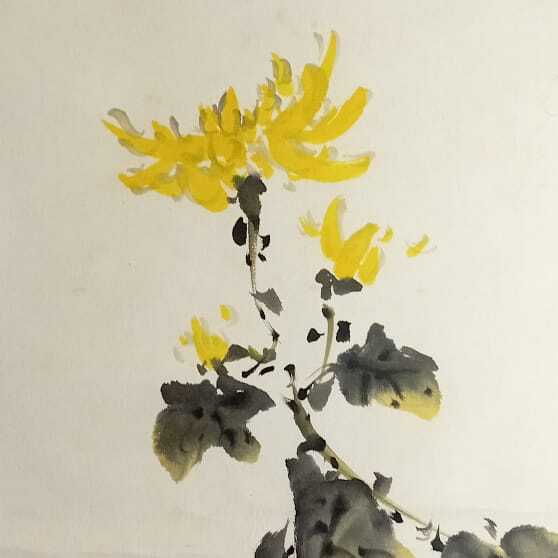
Kawai Seiji 川合誠司 1927–2008
Works on Shikishi
Kawai Seiji was a Japanese nihonga and suibokuga artist associated with the artistic community of Nagoya and the Chukyo region. He was born in Nagoya in 1927 and studied under Kawabata Ryushi, one of the important reformers of twentieth-century Japanese painting and the founder of the Seiryusha exhibition association.
Kawai Seiji’s professional biography was connected with several important exhibition systems of postwar Japan. He exhibited at the Seiryuten and Inten exhibitions and later held a senior position in the Shin Bijutsu Kyokai, where he served as vice chairman. Within the exhibition system of this association, he received its Grand Prize, as well as the Minister of Education Prize and the Prime Minister’s Prize.
His biography also records participation in Japanese international art projects and exhibitions held in France, Spain, Italy, Switzerland, and Greece. These details present Kawai Seiji as an artist active not only in the regional art scene of Nagoya, but also within the broader postwar exhibition context.
Teaching was an important part of his career. Kawai Seiji taught nihonga and suibokuga at the Chunichi Culture Center and headed an art association. His role was therefore connected not only with the creation of his own works, but also with the transmission of Japanese painting traditions to a later generation of artists.
Two main directions can be seen in Kawai Seiji’s work. The first is connected with decorative nihonga: landscapes, seasonal subjects, and compositions in which traditional Japanese painting is combined with the expressive color sensibility of the postwar period. The second is more intimate: haiga, seasonal still lifes, flowers, fruits, insects, and small-format works in which an image is accompanied by a short poetic inscription.
This combination of exhibition nihonga, ink painting, haiga, and teaching activity makes Kawai Seiji a characteristic representative of the professional Japanese art world of the second half of the twentieth century.
Kawai Seiji’s professional biography was connected with several important exhibition systems of postwar Japan. He exhibited at the Seiryuten and Inten exhibitions and later held a senior position in the Shin Bijutsu Kyokai, where he served as vice chairman. Within the exhibition system of this association, he received its Grand Prize, as well as the Minister of Education Prize and the Prime Minister’s Prize.
His biography also records participation in Japanese international art projects and exhibitions held in France, Spain, Italy, Switzerland, and Greece. These details present Kawai Seiji as an artist active not only in the regional art scene of Nagoya, but also within the broader postwar exhibition context.
Teaching was an important part of his career. Kawai Seiji taught nihonga and suibokuga at the Chunichi Culture Center and headed an art association. His role was therefore connected not only with the creation of his own works, but also with the transmission of Japanese painting traditions to a later generation of artists.
Two main directions can be seen in Kawai Seiji’s work. The first is connected with decorative nihonga: landscapes, seasonal subjects, and compositions in which traditional Japanese painting is combined with the expressive color sensibility of the postwar period. The second is more intimate: haiga, seasonal still lifes, flowers, fruits, insects, and small-format works in which an image is accompanied by a short poetic inscription.
This combination of exhibition nihonga, ink painting, haiga, and teaching activity makes Kawai Seiji a characteristic representative of the professional Japanese art world of the second half of the twentieth century.