Hirose Fukashi / 広瀬不可止 1903–1983
Works on Shikishi
Hirose Fukashi was a Japanese modernist sculptor and abstract artist from Fukuoka, and a full member of the sculpture section of Nika-kai, one of the key independent art associations of twentieth-century Japan.
His artistic path was unusual and not strictly academic. After moving to Tokyo, he worked in a sign-painting studio and in the experimental toy workshop Rarirurero, while also studying painting. Later, after returning to Fukuoka, he encountered the tradition of Hakata dolls and began to study sculpture largely on his own. This background — toys, folk modelling, concise treatment of form, and independent experimentation — became an important foundation for his later artistic language.
In 1933, Hirose was first accepted to the Nika-ten exhibition. After the war, he became a kaiyū, or associate member, and later a full member of Nika-kai. His prewar works were mainly connected with figurative sculpture, but in the postwar period he turned toward abstraction. During the 1950s and 1960s, he developed a language of simplified and geometric forms, translating the human figure, relationships, and historical themes into sculptural volumes. Later, he returned to figuration, but in a highly reduced, almost emblematic form.
Hirose was an important figure in the artistic life of Fukuoka. He took part in the founding of the Fukuoka Prefectural Art Association and, after the war, in its revival; he later served as its vice chairman. His works are held by the Fukuoka Art Museum and the Fukuoka Prefectural Museum of Art. In 1980, he received the Fukuoka City Culture Award for sculpture.
One of Hirose’s most unusual public works was a monumental white-cement Brontosaurus created for Fukuoka Zoo in 1955. Measuring approximately 23 metres in length, the figure became part of the city’s visual memory and later acquired the status of a local legend.
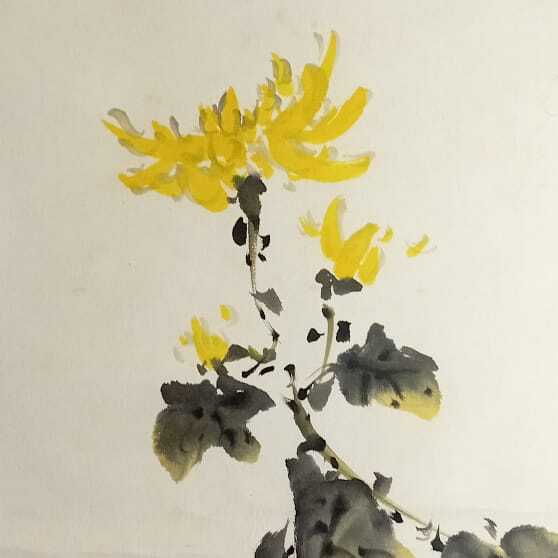
Hirose’s works on shikishi represent a little-known, intimate side of his practice. They can be seen as a two-dimensional continuation of his sculptural thinking: plants, animals, and human figures are reduced to concise, plastic forms. In these small works, the traditional Japanese shikishi format meets the language of postwar modernism and abstraction.
His artistic path was unusual and not strictly academic. After moving to Tokyo, he worked in a sign-painting studio and in the experimental toy workshop Rarirurero, while also studying painting. Later, after returning to Fukuoka, he encountered the tradition of Hakata dolls and began to study sculpture largely on his own. This background — toys, folk modelling, concise treatment of form, and independent experimentation — became an important foundation for his later artistic language.
In 1933, Hirose was first accepted to the Nika-ten exhibition. After the war, he became a kaiyū, or associate member, and later a full member of Nika-kai. His prewar works were mainly connected with figurative sculpture, but in the postwar period he turned toward abstraction. During the 1950s and 1960s, he developed a language of simplified and geometric forms, translating the human figure, relationships, and historical themes into sculptural volumes. Later, he returned to figuration, but in a highly reduced, almost emblematic form.
Hirose was an important figure in the artistic life of Fukuoka. He took part in the founding of the Fukuoka Prefectural Art Association and, after the war, in its revival; he later served as its vice chairman. His works are held by the Fukuoka Art Museum and the Fukuoka Prefectural Museum of Art. In 1980, he received the Fukuoka City Culture Award for sculpture.
One of Hirose’s most unusual public works was a monumental white-cement Brontosaurus created for Fukuoka Zoo in 1955. Measuring approximately 23 metres in length, the figure became part of the city’s visual memory and later acquired the status of a local legend.
Hirose’s works on shikishi represent a little-known, intimate side of his practice. They can be seen as a two-dimensional continuation of his sculptural thinking: plants, animals, and human figures are reduced to concise, plastic forms. In these small works, the traditional Japanese shikishi format meets the language of postwar modernism and abstraction.