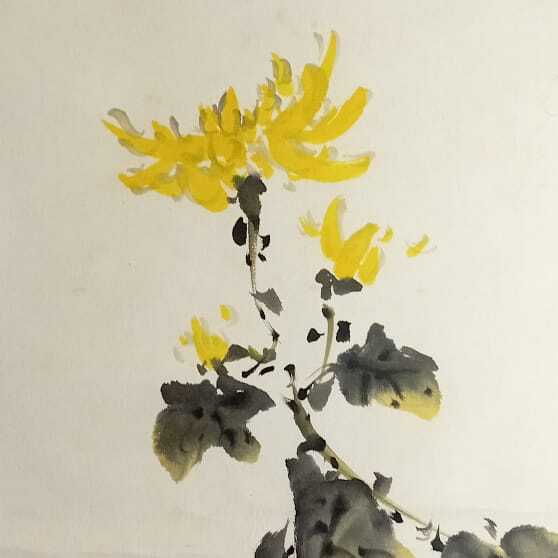
Akiyoshi Genpo / 秋吉玄圃 1902–?
Works on Shikishi
Akiyoshi Genpo was an Osaka-born Japanese painter of the nanga / nanshūga tradition. His year of birth is recorded as 1902; the year of death remains unknown in the available Japanese references.
Genpo belonged to the Kansai world of modern Southern School painting. His work is connected with bunjinga, or literati painting — a tradition in which landscape, plants, fish, seasonal subjects, poetry, calligraphy and Chinese classical culture form a connected artistic language. In this context, a small shikishi painting could carry the same cultural vocabulary as a larger hanging scroll: restrained seasonal imagery, an educated pictorial tradition, and a close relationship between painting and the classical arts.
In the 1920s, Genpo became known within the circle of modern nanshūga artists. His name appears in Japanese art-ranking materials of 1926 and 1927 among contemporary Southern School painters. Japanese biographical references describe him as a native of Osaka, with the personal name Motoji, and as a student of Mizuta Chikuho, one of the important masters of Kansai nanga. These references also record that Genpo’s works were selected for Bunten and Teiten, the major official exhibition systems of modern Japanese painting.
The teacher lineage is significant. Mizuta Chikuho was a central figure in the Kansai nanga revival and one of the founders of Nihon Nanga-in. Through Chikuho, Genpo is connected with the Osaka-Kyoto circle of painters who continued and renewed the Southern School tradition in the first half of the 20th century. This circle preserved the older literati relationship between painting, calligraphy, classical learning and seasonal subject matter, while working within the modern Japanese exhibition world.
Genpo’s surviving market corpus includes landscapes, auspicious and theatrical subjects, seasonal still-life compositions, fish, plants and small-format shikishi works. This range is characteristic of a nanga painter whose practice moved between formal scroll painting and more intimate works intended for close seasonal display. His shikishi paintings are especially useful for understanding this side of his work: compact in scale, but rooted in the same literati culture that shaped Kansai nanga.
His name is also listed in a Kansai University publication connected with Hakuen Shoin, the Osaka school of Chinese classical learning. This does not by itself define his training, but it supports the broader cultural setting in which his work should be understood: Osaka literati culture, Chinese classical studies, nanga painting and the modern Japanese art world of the early Shōwa period.
Genpo belonged to the Kansai world of modern Southern School painting. His work is connected with bunjinga, or literati painting — a tradition in which landscape, plants, fish, seasonal subjects, poetry, calligraphy and Chinese classical culture form a connected artistic language. In this context, a small shikishi painting could carry the same cultural vocabulary as a larger hanging scroll: restrained seasonal imagery, an educated pictorial tradition, and a close relationship between painting and the classical arts.
In the 1920s, Genpo became known within the circle of modern nanshūga artists. His name appears in Japanese art-ranking materials of 1926 and 1927 among contemporary Southern School painters. Japanese biographical references describe him as a native of Osaka, with the personal name Motoji, and as a student of Mizuta Chikuho, one of the important masters of Kansai nanga. These references also record that Genpo’s works were selected for Bunten and Teiten, the major official exhibition systems of modern Japanese painting.
The teacher lineage is significant. Mizuta Chikuho was a central figure in the Kansai nanga revival and one of the founders of Nihon Nanga-in. Through Chikuho, Genpo is connected with the Osaka-Kyoto circle of painters who continued and renewed the Southern School tradition in the first half of the 20th century. This circle preserved the older literati relationship between painting, calligraphy, classical learning and seasonal subject matter, while working within the modern Japanese exhibition world.
Genpo’s surviving market corpus includes landscapes, auspicious and theatrical subjects, seasonal still-life compositions, fish, plants and small-format shikishi works. This range is characteristic of a nanga painter whose practice moved between formal scroll painting and more intimate works intended for close seasonal display. His shikishi paintings are especially useful for understanding this side of his work: compact in scale, but rooted in the same literati culture that shaped Kansai nanga.
His name is also listed in a Kansai University publication connected with Hakuen Shoin, the Osaka school of Chinese classical learning. This does not by itself define his training, but it supports the broader cultural setting in which his work should be understood: Osaka literati culture, Chinese classical studies, nanga painting and the modern Japanese art world of the early Shōwa period.